Global power networks are expanding, and cable selection is becoming a procurement decision rather than a simple product choice. The International Energy Agency’s Electricity 2024 report forecasts average global electricity demand growth of 3.4% annually from 2024 to 2026. Renewable projects, data centers, electric transport, and industrial upgrades will all require dependable electrical cable. Behind every installation, practical details matter: conductor material, insulation, voltage rating, fire behavior, shielding, and installation temperature.
This guide examines ten widely traded electrical cable types for global buyers. It connects technical performance with real purchasing conditions, including export packaging, drum length, bend radius, certification, and replacement availability. The International Electrotechnical Commission publishes standards covering cables, conductors, testing, and low-voltage installations. Meanwhile, market studies from Grand View Research and MarketsandMarkets identify infrastructure expansion, renewable generation, and grid modernization as major cable-market drivers. These reports provide useful direction, but they do not replace project-specific engineering review.
That distinction matters.
A cable suitable for a dry indoor panel may fail in sunlight, buried soil, seawater, or constant movement. A cheaper cable can also create higher lifetime costs through difficult termination or early insulation damage. This overview therefore considers both specification and field reality. It reflects common procurement practice, while acknowledging that regional standards and approval requirements differ. No ranking can fit every project. Buyers should verify drawings, load calculations, environmental exposure, and conformity documents with qualified engineers before ordering. Small omissions can become expensive.
Top 10 Electrical Cable Types for Global Buyers
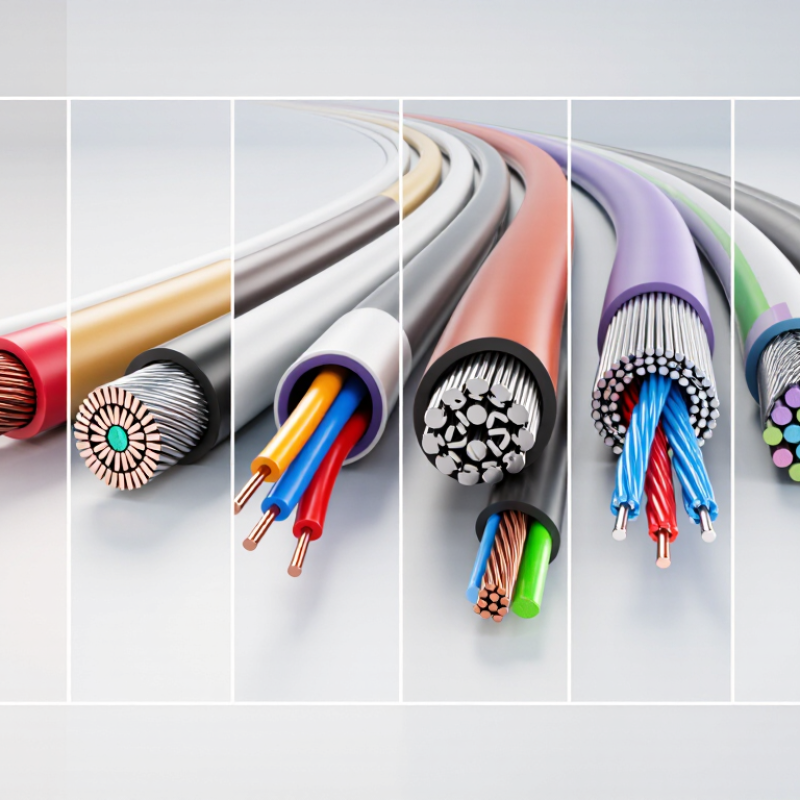
Electrical cables differ in construction, materials, and intended service. Common types include building wire, power cable, control cable, instrumentation cable, coaxial cable, twisted-pair cable, flexible cable, armored cable, fire-resistant cable, and photovoltaic cable. Each design solves a different installation problem.
A cable usually contains a copper or aluminum conductor, insulation, and an outer jacket. Copper carries current efficiently and bends easily. Aluminum weighs less and often reduces material cost. PVC provides practical insulation for many indoor applications. XLPE handles higher temperatures and stronger electrical stress. LSZH jackets can reduce smoke and corrosive gas during fires. Armored layers protect cables from crushing, impact, and rodents. Shielding also limits signal interference in sensitive circuits.
Performance depends on more than conductor size. Check voltage rating, ampacity, temperature range, bend radius, UV exposure, moisture, and fire behavior. In field inspections, installers often focus on the printed size and miss the jacket environment. That mistake can shorten service life. A cable may look excellent. It can still fail in heat or standing water. Verify test reports, conductor material, insulation thickness, and applicable regional standards before purchasing.
Tips: Match the cable to its route, not just its load. Measure long runs for voltage drop. Keep spare length at bends. Confirm certificates with the supplier and inspect packaging for damage. A careful sample check is cheaper than replacing an entire installation.
Top 10 Electrical Cable Types for Global Buyers
Electrical cable selection depends on voltage, environment, movement, and installation rules. Building wire serves lights, sockets, and distribution boards. Low-voltage power cable supports machinery, pumps, and commercial feeders. Medium-voltage cable connects industrial substations and local distribution networks. High-voltage cable links transmission systems and large renewable-energy projects. The IEA’s Electricity 2024 report expects global electricity demand to increase by more than 6% between 2024 and 2026. That growth will pressure every part of the grid.
Control cable carries switching and automation signals inside factories. Instrumentation cable protects sensitive measurement signals from electrical interference. Flexible cable suits robotic arms, portable tools, and moving equipment. Solar PV cable connects panels, combiner boxes, and inverters under sunlight and weather exposure. IRENA reported 473 GW of renewable capacity additions in 2023, showing why renewable cable demand is becoming more practical than theoretical. Small details matter.
Fire-resistant cable helps maintain essential circuits during an emergency, including alarms, pumps, and evacuation systems. Coaxial cable remains useful for radio-frequency equipment, antennas, and video transmission. Buyers should verify conductor material, insulation temperature, fire performance, shielding, and local certification. IEC standards provide a strong technical reference, but they do not replace project-specific testing. A neat specification can still fail in a wet, vibrating cable tray. I would also question very low prices; material savings may reduce service life, flexibility, or safety margins.
Top 10 Electrical Cable Types for Global Buyers
Cable selection starts with voltage, not price. The IEA’s Electricity 2024 report projects global electricity demand growth of about 4% in 2024 and 2025. That growth increases demand for dependable low-, medium-, and high-voltage cables.
Check the rating in full. A cable marked 0.6/1 kV has a conductor-to-earth rating of 0.6 kV and a conductor-to-conductor rating of 1 kV. Medium-voltage projects may use 6/10 kV, 12/20 kV, or higher systems. Match the cable with the network’s maximum operating voltage, fault level, and installation conditions. A rating that looks close may still be unsuitable.
Conductor choice affects weight, voltage drop, and termination work. Copper offers higher conductivity and easier jointing. Aluminium is lighter and usually less costly. International Aluminium Institute data places aluminium’s density near 2.7 g/cm³, compared with copper near 8.96 g/cm³. Its conductivity is about 61% of copper’s, so the cross-sectional area often must increase. Insulation also matters. PVC commonly supports 70°C conductor operation, while XLPE commonly supports 90°C under standard conditions. Always verify the applicable IEC requirement, such as IEC 60228 and IEC 60502. Field experience suggests many comparison sheets ignore soil temperature, grouping, and bending radius. That is a costly blind spot. A clean specification can still fail on site.
How to Compare Cable Voltage Ratings, Conductors, and Insulation
The chart compares representative maximum nominal voltage ratings. Actual selection should also consider conductor material and class, insulation system, installation environment, temperature, current capacity, shielding, and applicable regional standards.
| Cable type | Representative rating | Typical conductor | Common insulation |
|---|---|---|---|
| Flexible cord | 300/500 V | Flexible stranded copper | PVC or rubber |
| Instrumentation cable | 300/500 V | Stranded copper, often screened | PVC, PE, or XLPE |
| Building wire | 450/750 V | Solid or stranded copper | PVC |
| Control cable | 0.6/1 kV | Stranded copper | PVC or XLPE |
| Low-voltage XLPE power cable | 0.6/1 kV | Copper or aluminium | XLPE with PVC or PE sheath |
| Solar photovoltaic cable | 1.0 kV AC / 1.5 kV DC | Tinned flexible copper | Cross-linked halogen-free compound |
| Medium-voltage EPR cable | 12/20 kV | Copper or aluminium | EPR with metallic screen |
| Medium-voltage XLPE cable | 6/10 kV | Copper or aluminium | XLPE with metallic screen |
| High-voltage XLPE cable | 127/220 kV | Copper or aluminium | XLPE with lead or aluminium sheath |
| Submarine power cable | 64/110 kV | Copper or aluminium | XLPE, metallic sheath, and armour |
Reference framework: IEC 60227, IEC 60502-1, IEC 60840, IEC 62067, EN 50618, and commonly used IEC voltage designations. Ratings shown are representative and should be verified against the project specification.
Top 10 Electrical Cable Types for Global Buyers
Global Standards, Certifications, and Regional Compliance Requirements
A practical top ten includes building wire, flexible cord, control cable, instrumentation cable, low-voltage power cable, medium-voltage cable, fire-resistant cable, armored cable, solar cable, and data cable. Each type needs a different compliance path. IEC 60227 and IEC 60245 cover common PVC and rubber-insulated cables. IEC 60502 addresses many power cable designs. Higher-voltage projects may require IEC 60840 or IEC 62067 testing.
Certification is never one-size-fits-all. In the United States, buyers often check NEC installation rules and UL product requirements. Canada may require CSA certification. European construction cables can fall under EN 50575 and the Construction Products Regulation. Australia and New Zealand commonly use AS/NZS standards with RCM obligations. Other markets may request national approvals, customs documents, or local test reports. Check the destination before production.
A reliable supplier should provide a current datasheet, test certificate, conductor material details, voltage rating, flame results, and batch traceability. Look for laboratory accreditation under ISO/IEC 17025. I have seen projects delayed because a valid IEC report did not satisfy a local authority. That mistake is expensive. Certificate numbers also deserve verification. Standards change, and old documents can look convincing. Temperature, fire performance, bending radius, and installation environment still need technical review. Paperwork cannot replace engineering judgment.
| No. | Cable Type | Typical Voltage / Construction | Key International Standards | Common Certifications and Conformity Evidence | Regional Compliance Requirements | Typical Applications |
|---|---|---|---|---|---|---|
| 1 | PVC-Insulated Building Wire | Usually 300/500 V or 450/750 V; copper or aluminium conductor with PVC insulation. | IEC 60227 IEC 60332-1-2 EN 50525 | CE marking where the Low Voltage Directive applies; UKCA where applicable; national safety marks or certification may be required for the destination market. | European markets commonly require harmonised EN specifications and applicable CPR classification for permanently installed construction cables. North American projects normally specify regionally recognised wire types such as building-wire categories under the applicable electrical code. China may require CCC certification for covered product categories. | Residential and commercial wiring, lighting circuits, distribution boards, and conduits. |
| 2 | XLPE-Insulated Low-Voltage Power Cable | Typically 0.6/1 kV; copper or aluminium conductor, XLPE insulation, PVC or low-smoke outer sheath. | IEC 60502-1 IEC 60332 IEC 60754 IEC 61034 | CE or UKCA where applicable; CPR assessment for construction applications in Europe; test reports for conductor resistance, voltage, flame propagation, and routine testing. | EU buyers should verify CPR reaction-to-fire class and Declaration of Performance when the cable is permanently incorporated into construction works. Australia and New Zealand commonly reference AS/NZS 5000.1. North American installations usually require listed cable constructions compatible with NEC or CEC requirements. | Industrial distribution, commercial buildings, utilities, data centres, and renewable-energy balance-of-system installations. |
| 3 | Armoured Low-Voltage Power Cable | Usually 0.6/1 kV; XLPE or PVC insulation with steel wire armour, aluminium wire armour, or equivalent mechanical protection. | IEC 60502-1 IEC 60332 IEC 60754 IEC 61034 | CE or UKCA where applicable; CPR documentation for applicable construction products; independent inspection or project approval may be requested for armour, sheath, and fire-performance tests. | European specifications often distinguish steel wire armoured and aluminium wire armoured designs and require CPR classification for fixed building installations. Gulf and African projects frequently add outdoor, UV, sand, temperature, and gland requirements. Local installation rules determine whether armour can serve as a protective conductor. | Underground feeders, industrial plants, outdoor distribution, infrastructure, and heavy-duty commercial installations. |
| 4 | Medium-Voltage XLPE Power Cable | Commonly 3.6/6 kV to 18/30 kV; semiconductive screens, XLPE insulation, metallic screen, and optional armour. | IEC 60502-2 IEC 60811 IEC 60228 | Type-test and routine-test certificates; CE or UKCA where applicable; utility approval, third-party witnessing, partial-discharge testing, and factory acceptance testing are commonly required. | Utility specifications may impose specific metallic-screen cross-sections, bonding methods, water-blocking requirements, and permissible conductor temperatures. North American projects often use IEEE-based MV cable specifications and locally recognised listings. Installation must comply with the national electrical code and utility rules. | Utility feeders, substations, wind and solar farms, industrial networks, and large commercial complexes. |
| 5 | High-Voltage XLPE Power Cable | Typically above 30 kV up to 150 kV; XLPE insulation with metallic screens, water barriers, and engineered accessories. | IEC 60840 IEC 60228 IEC 60811 | Complete type-test evidence, prequalification or system testing where specified, routine and sample tests, partial-discharge results, and project-specific utility acceptance. | Transmission and distribution authorities generally require approved cable systems, including joints and terminations, rather than cable-only approval. Environmental design may require radial water blocking, lead or aluminium moisture barriers, special sheaths, and low-temperature qualification. | Sub-transmission networks, urban grid reinforcement, substations, industrial power links, and renewable-energy evacuation systems. |
| 6 | Extra-High-Voltage Cable | Commonly above 150 kV up to approximately 500 kV; engineered XLPE system with specialised insulation screens and accessories. | IEC 62067 IEC 60228 IEC 60811 | Prequalification testing, full type testing, electrical and thermal performance evidence, factory acceptance testing, installation supervision, and system-level approval by the network operator. | Requirements are usually defined by transmission-system operators and national grid codes. Buyers should confirm cable-system compatibility, laying configuration, thermal resistivity assumptions, bonding design, induced-voltage limits, and accessory qualification before procurement. | Major transmission corridors, interconnectors, power plants, metropolitan grids, and high-capacity renewable-energy links. |
| 7 | Fire-Resistant and Circuit-Integrity Cable | Low- or medium-voltage designs using fire-resistant insulation and screened or armoured constructions; circuit-integrity ratings vary by test method. | IEC 60331 IEC 60332 EN 50200 BS 8519 | Fire-resistance test reports, classification or listing to the specified national method, CPR classification where applicable, and compatibility evidence for cable supports, glands, joints, and termination systems. | Europe may require CPR reaction-to-fire classification in addition to circuit-integrity performance. The United Kingdom commonly specifies BS-based fire-survival requirements for life-safety systems. North American projects generally use fire-resistive or circuit-integrity requirements defined by the applicable building and electrical codes. | Emergency lighting, fire alarms, smoke control, evacuation systems, pumps, elevators, and critical infrastructure. |
| 8 | Low-Smoke Zero-Halogen Cable | Usually 300/500 V, 450/750 V, or 0.6/1 kV; halogen-free insulation and sheath with reduced smoke emission. | IEC 60754 IEC 61034 IEC 60332 EN 50575 | CE and Declaration of Performance when covered by the EU Construction Products Regulation; UKCA where applicable; test evidence for halogen-acid gas, smoke density, flame spread, and mechanical performance. | Often specified in transport hubs, tunnels, public buildings, data centres, and confined spaces. European buyers should distinguish true halogen-free performance from low-smoke PVC and verify the declared CPR class. Local fire codes may require additional toxicity, smoke, or circuit-integrity performance. | Hospitals, airports, rail systems, public buildings, tunnels, data centres, and offshore facilities. |
| 9 | Photovoltaic Solar Cable | Typically 1.0/1.0 kV or 1.5/1.5 kV DC; flexible tinned copper conductor with UV-, ozone-, and weather-resistant insulation and sheath. | IEC 62930 EN 50618 IEC 60228 IEC 60332 | CE or UKCA where applicable; CPR assessment for permanent building installations in Europe; project or national certification may be required for PV systems, connectors, and installation components. | Europe commonly uses EN 50618 or equivalent harmonised requirements. North American systems frequently specify PV wire constructions recognised for the applicable NEC installation. Buyers should verify DC voltage rating, maximum conductor temperature, UV exposure, bend radius, compatibility with connectors, and rooftop fire requirements. | Solar modules, string wiring, combiner boxes, rooftop systems, utility-scale solar farms, and battery-coupled PV installations. |
| 10 | Marine and Offshore Cable | Low- and medium-voltage flexible or fixed installations; flame-retardant, oil-resistant, vibration-resistant, and often low-smoke or halogen-free. | IEC 60092-350 IEC 60092-353 IEC 60092-359 IEC 60332 | Marine type approval or product certification from the vessel’s selected classification society; flag-state, port-state, and offshore project requirements may also apply. | Vessel and offshore projects normally require compliance with the applicable International Maritime Organization framework, classification rules, and flag-state regulations. Cables must be selected for marine atmosphere, fire performance, oil exposure, vibration, bending, and installation-space limitations. | Ships, offshore platforms, marine renewable-energy systems, shipyards, ports, and offshore substations. |

Selecting electrical cables requires more than comparing prices. Start with the load. Define voltage, current, frequency, installation method, and expected service life. Building wire suits indoor circuits, while THHN/THWN cables handle many commercial applications. PVC-insulated cables offer economical protection. XLPE cables tolerate higher temperatures and demanding power systems. Armored cables add mechanical protection in buried or exposed installations.
Environment changes everything. Flexible cables support moving equipment and temporary connections. Coaxial cables serve signal transmission, while twisted-pair cables reduce interference in communication systems. Solar cables resist sunlight and outdoor heat. Control cables connect sensors, switches, and automation equipment. Fire-resistant cables can maintain circuit function during emergencies, where local regulations permit their use.
Check the conductor material, cross-sectional area, insulation rating, bending radius, and flame behavior. Copper usually provides strong conductivity, while aluminum can reduce weight and material cost. Confirm compliance with the destination country’s electrical code and request independent test reports. Ask for samples. Inspect the printing, conductor stranding, insulation thickness, and drum labeling before placing a large order. Supplier documents should state batch numbers, production dates, and test conditions. Lead time, minimum order quantity, packaging, and shipping damage protection also affect the real purchase cost. A low quotation may hide thinner insulation or incomplete certification. A checklist helps, but it cannot replace technical review. Recheck unusual specifications with a qualified engineer.