10 Tips for Buying the Right Flexible Conduit?

Choosing the right flexible conduit is more than comparing prices or selecting the thickest wall. The correct product must protect cables while fitting the installation’s movement, heat, moisture, and space limitations. A conduit that looks suitable in a catalog may flatten around a sharp bend or crack beside a hot motor.

This guide presents ten practical tips for evaluating flexible conduit with greater confidence. It considers material, internal diameter, bend radius, operating temperature, ingress protection, fittings, grounding needs, and installation conditions. It also explains why manufacturer data, test reports, and recognized standards should support every important decision. IEC 61386 requirements, UL listings, or equivalent regional certifications may matter, depending on the project and location.

Field experience often reveals details that specifications miss. Pulling a cable through an undersized conduit can damage insulation and waste hours. Too much bending can reduce service life. Poorly sealed fittings can allow dust or water to enter unnoticed. Small choices matter.

Still, no buying checklist is perfect. Even experienced installers sometimes overlook future cable replacement or actual movement during operation. That is why each recommendation should be checked against the equipment, site conditions, and supplier documentation. Reliable advice is not about choosing one universal product. It is about matching the flexible conduit to a clearly understood application, then verifying that choice before installation.
10 Tips for Buying the Right Flexible Conduit?

Define Flexible Conduit Types and Their Intended Applications

Flexible conduit is not one universal product. Each type serves a different installation environment.

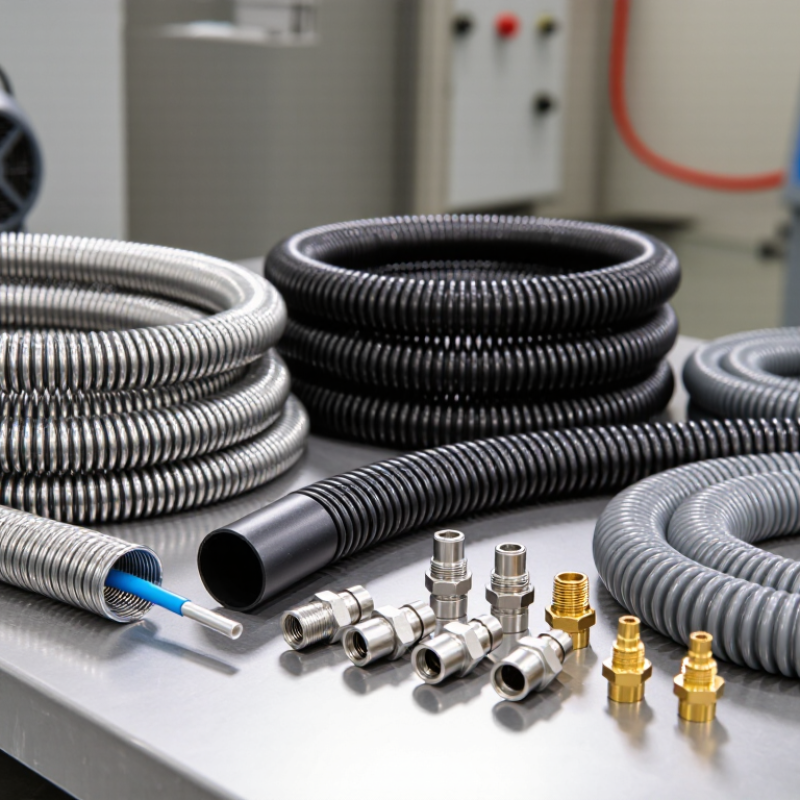
Metallic flexible conduit offers mechanical protection and supports grounding when installed correctly. It suits machinery, control panels, and areas exposed to impact.

Nonmetallic flexible conduit is lighter and resists corrosion. It works well in damp spaces and around equipment that moves slightly.

Liquid-tight conduit adds a sealed outer jacket for washdown areas, outdoor connections, and locations with oil or moisture.

Electrical metallic tubing is not flexible conduit, despite occasional confusion.

Tip 1: Identify the environment before choosing the material.
Tip 2: Check whether the conduit must resist water, chemicals, heat, or abrasion.
Tip 3: Confirm the cable diameter and allow room for pulling.

Tip 4: Match the bending radius to the equipment movement.
Tip 5: Verify connector compatibility.

Small details matter. A tight bend can damage insulation and make maintenance difficult. In field inspections, incorrect fittings are surprisingly common.

Tip 6: Use grounding methods required for the installation.
Tip 7: Choose liquid-tight protection near pumps, wash stations, or exterior equipment.
Tip 8: Avoid using flexible conduit as a substitute for structural support.

Tip 9: Measure the route, including service loops and movement.
Tip 10: Review temperature ratings against real operating conditions.

I have seen conduit selected by appearance alone, which is a weak method.

Recheck the choice against local electrical codes and the manufacturer’s technical data. There is no perfect type; the application decides.

Assess Environmental Conditions and Required Protection Levels

Environmental conditions should guide every flexible conduit decision. Start with the installation location, not the product shelf. Is the conduit indoors, outdoors, underground, or near moving machinery? Each setting creates different risks. Outdoor sunlight can make ordinary materials brittle. Standing water can enter through poorly sealed fittings. Fine dust may reach terminals and cause overheating.

Temperature matters more than many buyers expect. Check both the lowest and highest operating temperatures. A conduit beside a furnace needs different protection from one inside a cool control cabinet. Chemical exposure also deserves careful attention. Oils, cleaning agents, salt spray, and coolants can weaken some materials over time. I once saw a flexible section crack beside a machine because heat and chemical mist were considered separately, not together. That was an avoidable mistake.

Match the conduit’s protection level to the actual hazard. Look for verified resistance to water, dust, impact, crushing, abrasion, and repeated bending. An ingress rating can help, but only when the complete assembly meets that rating. The conduit, connectors, seals, and cable entry must work as one system. Check whether the route vibrates or moves daily. A stiff conduit may protect well but fail quickly under constant flexing. Leave enough bend radius, and avoid sharp turns near fittings. Review the manufacturer’s technical data and applicable local electrical requirements before installation. Small details matter. Still, field conditions can be messier than the specification sheet. Recheck the route after installation.

Match Conduit Size, Flexibility, and Bending Requirements

Buying the right flexible conduit starts with the cable bundle, not the conduit price. Measure the outside diameter of every cable, then allow room for pulling and heat dissipation. NFPA 70 (2023), Chapter 9, Table 1 limits conduit fill to 40% when three or more conductors share a raceway. That figure is practical, not decorative. A crowded conduit can increase pulling force and damage insulation. Check the required bend radius, too. A short, tight turn may exceed the conduit’s rated limit, even when the installation looks neat.

Flexibility must match movement. A stationary control panel may need moderate flexibility, while robotics or vibrating equipment requires a conduit rated for repeated bending. IEC 61386-1 evaluates conduit performance through tests for bending, compression, impact, and temperature resistance. Review those classifications before choosing a lighter construction. It may feel flexible by hand. That can be misleading. I once underestimated the space needed near a sharp enclosure entry, creating an awkward loop and unnecessary stress. The better method is to sketch the route, mark each bend, and compare the measured radius with the manufacturer’s technical data. Also verify fitting size, cable compatibility, environmental exposure, and installation temperature. A larger conduit is not always safer, but choosing the smallest workable size often leaves little room for error.

10 Tips for Buying the Right Flexible Conduit: Match Conduit Size, Flexibility, and Bending Requirements
Tip Buying Factor Practical Reference What to Check Before Buying
1 Match the conduit size to the cable bundle The conduit must provide enough internal area for the insulated conductors, connectors, and pulling clearance. Electrical codes commonly limit conduit fill; for three or more conductors, a 40% maximum fill is widely used in common installation rules. Measure the cable outside diameters, calculate the required internal area, and select the next suitable trade size rather than forcing an undersized conduit.
2 Allow for future cables A conduit that is completely full is harder to pull, inspect, and modify. Spare capacity also reduces the risk of damaging insulation during installation. If future expansion is likely, choose a larger conduit or install a separate pathway. Do not use the full internal diameter as usable cable space.
3 Check the minimum bend radius Flexible conduit has a minimum bend radius specified by its construction and size. The value may be given as a measured radius or as a multiple of the conduit outside diameter. Compare the product’s minimum static and dynamic bend-radius ratings with the tightest bend in the proposed route. Never use a bend tighter than the published limit.
4 Separate static and continuous-flexing needs A conduit suitable for occasional adjustment or vibration may not withstand repeated movement on a machine axis, robotic arm, or drag-chain application. Identify whether the conduit will remain stationary, move occasionally, or flex continuously. For continuous movement, verify cycle life, travel speed, acceleration, and torsion ratings.
5 Select the correct flexibility level Smaller sizes and lighter constructions are generally easier to bend, while heavy-duty constructions provide greater mechanical protection but may require more bending force and space. Balance ease of installation against crush, impact, and abrasion protection. Do not choose the most flexible option if the installation requires high mechanical strength.
6 Confirm environmental protection Moisture, dust, oil, chemicals, ultraviolet exposure, salt spray, and outdoor weather can degrade unsuitable conduit jackets, fittings, or seals. An IP rating applies to a complete assembled system, not just the conduit alone. Check the required enclosure rating and confirm that the conduit, connectors, gaskets, and end fittings are all compatible with the environment.
7 Verify temperature limits The allowable temperature is determined by the conduit material, cable insulation, fittings, and installation conditions. High ambient temperature can reduce the usable rating of some polymers and seal materials. Compare the minimum and maximum operating temperatures with the actual ambient temperature, conductor heating, sunlight, and nearby heat sources.
8 Check electrical and grounding requirements Some metallic flexible conduits can provide a bonding or grounding path when installed with approved fittings; nonmetallic conduit generally requires a separate grounding conductor where required by the installation rules. Confirm whether the conduit must provide mechanical protection only or also serve as part of the grounding and bonding system. Use compatible, approved fittings at every termination.
9 Match fittings and entry geometry A conduit system performs properly only when the conduit, straight connectors, 90-degree fittings, strain reliefs, locknuts, seals, and enclosure entries are compatible in size and thread type. Specify the conduit trade size, fitting thread standard, entry angle, sealing method, and cable-relief requirement together. Check whether the fitting preserves the required bend radius.
10 Confirm standards, approvals, and installation limits Electrical and machinery installations may require compliance with applicable national or regional standards, enclosure ratings, flame behavior requirements, and use-specific approvals. Request the technical datasheet, dimensional drawing, temperature range, bend-radius data, load ratings, and relevant conformity or certification information before placing the order.
Important: Conduit dimensions, fill limits, bend radii, temperature ratings, and approvals vary by construction and application. Always verify the final selection against the applicable electrical code, machinery standard, installation conditions, and the manufacturer’s current technical datasheet.

Verify Material Compatibility, Durability, and Safety Standards

10 Tips for Buying the Right Flexible Conduit?

Material compatibility should guide every conduit purchase. Check the jacket against oils, solvents, moisture, ultraviolet exposure, and operating temperature. A conduit that survives installation may still crack beside a hot motor. Review the manufacturer’s chemical-resistance table, but question vague claims. Laboratory ratings do not perfectly represent dusty, wet job sites. The cable insulation must also fit without abrasion or excessive compression. Leave room for movement.

Durability requires more than a thick outer wall. Inspect bend radius, tensile strength, impact resistance, and repeated-flex performance. IEC 61386-1 establishes general requirements for conduit systems, including mechanical and environmental performance. Ask for test documentation, not just a compliance logo. NFPA’s Electrical Fires report estimated 32,000 U.S. home structure fires annually from electrical failures during 2015–2019. Those incidents caused about 470 civilian deaths and $1.3 billion in direct property damage each year. Flexible conduit cannot prevent every failure, but poor protection can increase exposure to damage.

Safety standards must match the installation environment. Confirm temperature ratings, flame behavior, ingress protection, grounding continuity, and connection strength. Use fittings designed for the conduit type. A loose fitting can admit water or strain conductors. Field checks matter. Pull gently, inspect both ends, and look for flattened sections after routing. I would not rely on appearance alone; that shortcut has caused expensive rework. Keep the test records with the project file. Small gaps in documentation become big questions during inspection.

Compare Installation Needs, Maintenance, and Total Purchase Cost

10 Tips for Buying the Right Flexible Conduit?

Compare Installation Needs, Maintenance, and Total Purchase Cost

A conduit should match the route, environment, and cable load. Measure the path carefully, including bends, entry points, and movement zones. Small mistakes create expensive rework. Check the minimum bend radius before ordering. A tight bend can damage cables or slow installation. Match the inner diameter to the cable bundle, leaving practical space for pulling and future replacement. Do not treat maximum fill as a target.

In field installations, I have seen outdoor conduit fail early because moisture protection was assumed, not verified. Check temperature, water, oil, dust, vibration, and chemical exposure. Confirm the material’s flexibility after installation, not only in the warehouse. Review test data, safety documentation, and applicable installation standards. Select fittings that match the conduit and enclosure. Mixed components may connect poorly. That detail is easy to miss.

Maintenance affects the real purchase cost. Choose routes that remain accessible, and avoid burying inspection points behind permanent structures. Inspect seals, clamps, and exposed sections during scheduled service. Keep spare fittings, but do not overstock unusual sizes. Compare purchase price, labor time, tools, replacement intervals, shipping, and disposal costs. A cheaper conduit may require more clamps or earlier replacement. I once underestimated installation labor, and the product price became almost irrelevant. Recheck the estimate with actual site conditions. Estimates can be wrong.

10 Tips for Buying the Right Flexible Conduit

Compare Installation Needs, Maintenance, and Total Purchase Cost

The chart uses a practical planning index for common flexible conduit categories. Values combine typical installation effort, expected maintenance burden, and initial purchase cost per comparable project quantity. Lower scores indicate a more favorable result; actual costs vary by size, protection rating, labor rates, environmental conditions, and installation complexity.