Top Digital Watch Manufacturers for Global Buyers

Selecting a Digital Watch manufacturer is not simply a search for the lowest quote. Global buyers must weigh product reliability, production capacity, component traceability, customization, and after-sales support. A polished sample can look convincing under showroom lights. Long-term performance is harder to judge. It depends on battery life, display readability, water resistance, and consistent assembly across production runs.

Industry data shows why the category deserves careful attention. Grand View Research estimated the global smartwatch market at USD 33.58 billion in 2023 and projected an 8.9% compound annual growth rate from 2024 to 2030. Counterpoint Research, however, reported that global smartwatch shipments fell 7% in 2024. These figures measure different things: market revenue and unit shipments. They also cover smartwatches, not every type of digital watch. That distinction matters when comparing suppliers or forecasting demand.

This guide introduces leading manufacturers for buyers seeking dependable production partners across regions. It considers their product focus, manufacturing strengths, customization options, and ability to support different order volumes. Buyers should also request clear specifications, sample testing, quality-control details, and realistic lead times before making a decision. A supplier’s catalog alone is not proof of factory capability. Nor does a large company automatically suit every project. Some comparisons will remain imperfect, because public information rarely reveals the full picture. The aim is to help buyers ask sharper questions and build a shortlist grounded in evidence.
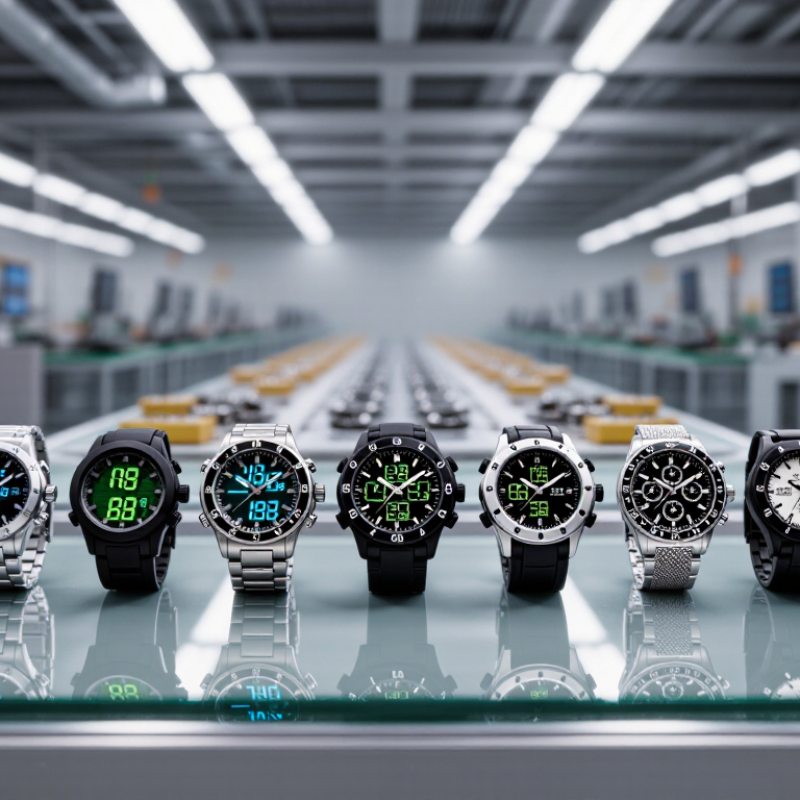
Top Digital Watch Manufacturers for Global Buyers

What Defines a Digital Watch Manufacturer in the Global Market

Top Digital Watch Manufacturers for Global Buyers

What Defines a Digital Watch Manufacturer in the Global Market

A digital watch manufacturer does more than assemble a case, screen, and strap. It manages design, component sourcing, production controls, and testing across repeat orders. Buyers should ask for clear specifications, sample approval records, and documented checks for display accuracy, battery performance, and water resistance. Samples matter. A polished prototype can still hide uneven mass production.

Market demand also makes supplier capability worth checking. IDC’s Worldwide Quarterly Wearable Device Tracker forecast 537.9 million wearable-device shipments worldwide in 2024, up 6.1% from 2023. Wearables include products beyond digital watches, so this figure is market context, not a watch-only count. A capable manufacturer should explain its production capacity and quality process without relying on broad claims. Ask how it tracks components and handles defects; even experienced buyers can overlook these details.

Tips: Request a pre-production sample and written test criteria. Confirm who provides after-sales support and how replacement parts are managed. Small details count. If answers are vague, pause and reassess.

How Digital Watches Are Designed and Manufactured

How Digital Watches Are Designed and Manufactured

A digital watch begins with use conditions, not a screen graphic. Designers define readability, water exposure, impact risk, battery life, and target cost. Case dimensions are then tested against actual wrist movement; a watch that looks balanced in a rendering may press uncomfortably against the wrist. Small detail, real consequence.

Engineers select the display, quartz timing circuit, buttons, battery, and sealing structure as one system. A brighter backlight can improve visibility but drain power faster. The circuit board is assembled, programmed, and checked for timing accuracy before fitting into the case. Gaskets and button shafts need careful tolerances: even a slight mismatch can weaken moisture protection. Testing typically includes button-cycle, drop, temperature, and water-resistance checks, with results tied to defined test conditions.

Demand shapes production planning, but market figures need careful interpretation. IDC’s Worldwide Quarterly Wearable Device Tracker reported 534.6 million wearable-device shipments in 2024, up 6.1 percent year over year; that category includes products beyond digital watches. For global buyers, this broader signal supports checking a manufacturer’s capacity, component traceability, inspection records, and ability to keep specifications consistent across production batches. Sample approval matters. So does retesting after a component change. A polished prototype is not proof of stable mass production.

Leading Digital Watch Manufacturers and Their Regional Strengths

Digital-watch manufacturers draw strength from regional supply networks, not just assembly capacity. IDC’s Worldwide Quarterly Wearable Device Tracker estimated 534.6 million wearable-device shipments in 2024, up 6.1% year over year. The figure includes products beyond watches, so it signals ecosystem scale, not digital-watch demand alone. China and broader East Asia offer dense component networks, tooling access, and short supplier routes. These can help factories move from prototype to volume production quickly. Taiwan is known for electronics engineering and component expertise, while Japan brings depth in precision parts and quality control. Capabilities vary widely between factories.

Southeast Asian manufacturing hubs can offer buyers additional sourcing options and established export logistics. The World Bank’s 2023 Logistics Performance Index ranks countries on customs, infrastructure, and delivery reliability; Singapore ranked first. But strong logistics do not guarantee watchmaking skill. Not every factory fits the map. Ask for evidence: sample consistency, water-resistance test records, battery-life results, and supplier traceability. A neat showroom sample may hide uneven production batches. Regional reputation is a useful starting point, not a substitute for an on-site audit and a small pilot order.

Regional Strengths in the Digital Watch Supply Chain

Share of global semiconductor manufacturing capacity by location, 2020

Semiconductors are one component of digital watches, so manufacturing capacity offers a supply-chain context—not a direct measure of watch production or manufacturer market share.

Source: Semiconductor Industry Association and Boston Consulting Group, “Strengthening the Global Semiconductor Supply Chain in an Uncertain Era” (2021); 2020 capacity shares.

Key Technologies and Product Categories in Digital Watchmaking

Digital watchmaking spans basic LCD quartz models, solar-powered watches, hybrid analog-digital designs, and sensor-rich smartwatches. Their shared challenge is energy management. A crisp display means little if a small cell drains quickly. Low-power memory-in-pixel screens, efficient processors, and adaptive backlighting can extend runtime. Solar charging may reduce battery changes, though results depend on light exposure. Small details matter. Button travel, glove-friendly menus, and readable digits at noon can matter more than a long feature list.

IDC’s Worldwide Quarterly Wearable Device Tracker reported 534.6 million wearable-device shipments worldwide in 2024, up 6.1% year over year. This figure includes products beyond watches, so it signals ecosystem scale rather than digital-watch demand alone. Global buyers can compare display type, battery-life test conditions, water-resistance rating, sensor accuracy, and firmware-support period. Connected models also rely on radio modules and careful data handling; standalone quartz models avoid some of that complexity. There is a trade-off. Solar cells may charge slowly indoors, while touchscreens can be awkward with wet fingers. Specifications rarely show the whole experience. Test samples in bright sunlight and after repeated button presses before selecting a manufacturing partner.

How Global Buyers Evaluate Manufacturers and Suppliers

Global buyers should evaluate digital watch manufacturers on repeatable quality, not polished samples alone. A watch may look flawless, yet fail after repeated button presses or exposure to moisture. Ask for documented checks covering display consistency, timekeeping accuracy, battery life, water resistance, and final assembly. Request production samples from a regular run, not only a hand-finished prototype.

The ISO Survey 2023 reported about 1.26 million valid ISO 9001 certificates worldwide. Certification can indicate a quality management system, but it does not guarantee every watch meets your specification. Review recent inspection records, corrective-action reports, and component traceability. The World Bank’s 2023 Logistics Performance Index assessed 139 economies across six dimensions, including customs, tracking, and timeliness. Use those dimensions to question suppliers about export paperwork, shipment visibility, and realistic delivery windows. No spreadsheet catches everything.

Tips: Compare the same test criteria across suppliers. Ask who owns the tooling and firmware files, and how design changes are approved. Check a small pilot order before committing to larger volumes. A rushed audit can miss important gaps; allow time to verify claims.