How to Choose the Best Clip On Study Lamp?
Choosing a Clip On Study Lamp is not just a matter of finding the brightest bulb. It is about placing useful light where your eyes and hands need it. The Illuminating Engineering Society’s guidance treats illuminance as task-dependent; reading and writing needs differ from fine-detail work. A practical starting point is roughly 300–500 lux on the desk, then adjusting for room brightness, glare, and personal comfort. Check the actual light at the page, not only the lamp’s advertised lumen output.
There is a health dimension, too. Dr. Mariana Figueiro, director of Mount Sinai’s Light and Health Research Center, has described light as “the most powerful synchronizer of the circadian system.” That is a reason to consider color temperature and evening use, not a promise that one desk lamp will improve sleep. The U.S. Department of Energy reports that LED lighting uses at least 75% less energy and can last up to 25 times longer than incandescent lighting. For a clip-on model, LED efficiency matters, but so do replaceable parts, stable brightness, and a secure clamp.
Small details count. A shade that directs light onto a workbook can reduce spill across a dark bedroom. A flexible arm helps, unless it slowly droops during a long study session. No lamp is perfect. This guide compares brightness, color, clamp fit, adjustability, and power options, while acknowledging that comfort varies from desk to desk.
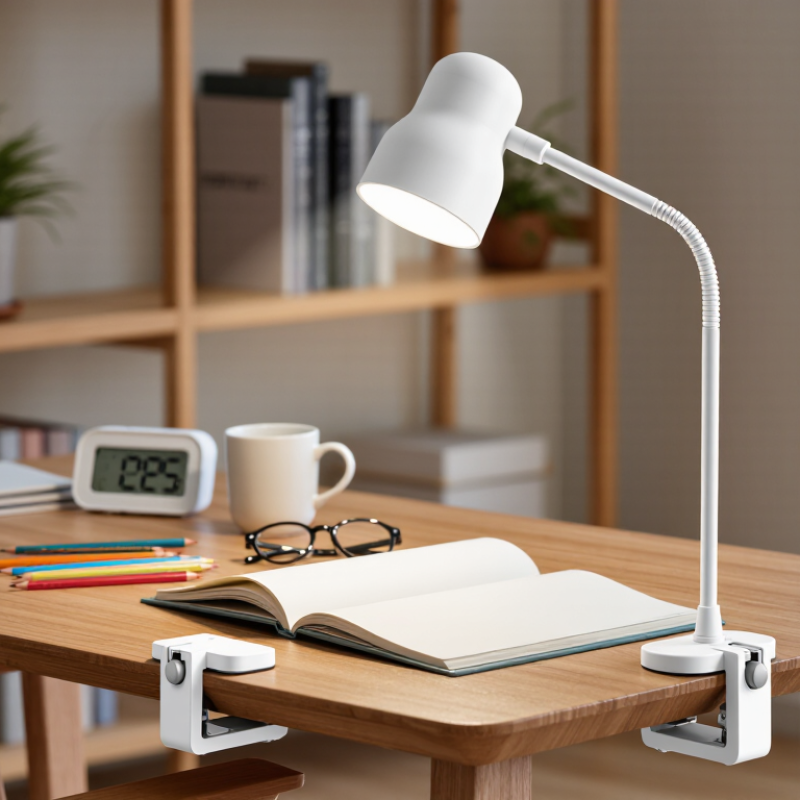
Set a 500 lx Reading-Light Benchmark Based on EN 12464-1
How to Choose the Best Clip On Study Lamp?
Use 500 lx as a practical reading-light benchmark. EN 12464-1 sets maintained illuminance levels for visual tasks in indoor workplaces, including reading and writing. It is not a blanket requirement for every home lamp, nor does meeting the figure certify a lamp. Still, it gives you a useful target to check at your desk.
Measure the light on the page, not at the lamp head. Place a lux meter flat beside the book, then check several spots across the reading area. A single bright patch can hide dim corners. Adjust the clip lamp’s position and angle until the page is evenly lit, without a sharp reflection or a shadow from your writing hand. Small changes matter.
Check that the clip grips the desk or shelf securely and that the arm stays in place when adjusted. A shade that directs light onto the book can reduce glare on a glossy screen nearby. The 500 lx figure is a starting point; comfortable brightness also depends on room lighting, eyesight, and the task. One caveat: inexpensive meters may vary, so treat readings as estimates rather than lab results.
Compare Glare and Color Rendering: UGR ≤19 and Ra ≥80
When choosing a clip-on study lamp, check both glare control and color rendering. UGR ≤19 is a useful target for comfortable desk lighting, but UGR depends on the room, viewing angle, and fixture position. A number on a product page cannot predict every setup. Look for a shade that hides the bright light source from your eyes and directs light onto the page. A matte desk can help reduce reflections. So can a small adjustment.
Tips: Clip the lamp firmly to a shelf or desk edge. Aim the beam at your book, not toward your face or a glossy screen. Sit in your usual position and check for bright spots. Small changes matter.
Ra ≥80 means colors should look reasonably natural for everyday reading and note-taking. It is a sensible baseline for seeing colored diagrams, highlighting, and printed charts without obvious dullness. If color accuracy matters for art or detailed visual work, consider a higher Ra value. Still, Ra alone does not describe brightness or glare. Check whether the lamp offers adjustable output and a diffuser, then test it at night with the room lights as you normally use them. The page should look clear, not harsh. One spec may look perfect, yet feel wrong at your desk.
How to Choose the Best Clip-On Study Lamp
Compare glare and color rendering using two common lighting criteria.
A lower Unified Glare Rating (UGR) indicates less discomfort glare; ≤19 is a commonly used target for reading and office environments. Color rendering index (Ra) runs from 0 to 100, with ≥80 a common minimum for indoor task lighting. These are general selection criteria, not results for a specific lamp; applicable requirements can vary by setting.
Match Clip Capacity and Arm Reach to Your Desk and Study Area
A clip-on study lamp should fit the desk before you judge its brightness. Measure the desk edge, including any lip or cable tray, and check the clamp’s opening range. A thick shelf can defeat a sturdy-looking clip. Leave room for the clamp’s screw or pad, too; it needs a flat, stable surface to hold securely. On a narrow desk, a broad base may crowd books, while a compact clip can free that space.
Arm reach matters just as much. Measure from the clamp point to the center of your open book or keyboard, then choose an arm that reaches without stretching over your head. The Illuminating Engineering Society’s task-lighting guidance commonly uses about 300–500 lux for reading and other close work. Reach helps aim light onto the page, not into your eyes. For a simple check, place a lux meter where you read; readings change with distance and shade angle. A long arm can still wobble. I’ve learned to check the joints, not just the advertised reach. One small compromise: a shorter arm may be easier to position on a crowded desk.
How to Choose the Best Clip-On Study Lamp: Match Clip Capacity and Arm Reach to Your Desk and Study Area | Study Setup | Typical Desk Edge Thickness | Suggested Clip Opening | Useful Arm Reach | Best Fit and Placement |
| Compact desk for a laptop and notebook | 0.5–1.2 in (13–30 mm) | At least 1.4 in (36 mm) | 12–16 in (30–41 cm) | A short-to-medium arm can illuminate the notebook without taking up desk space. Check that the clip fits the desk edge and that the lamp head can angle toward the page. |
| Standard writing or homework desk | 0.7–1.6 in (18–40 mm) | At least 1.8 in (46 mm) | 16–20 in (41–51 cm) | A medium-reach arm generally offers room to position the light over books or worksheets while keeping the clamp near a back corner. |
| Deep desk or wide study surface | 0.8–1.8 in (20–46 mm) | At least 2.0 in (51 mm) | 20–24 in (51–61 cm) | Choose a longer arm if the lamp must reach from the rear edge toward the middle of the desk. Confirm that the head can be aimed downward without the arm obstructing a monitor. |
| Thick tabletop or desk with a reinforced edge | 1.5–2.4 in (38–61 mm) | At least 2.6 in (66 mm) | 16–22 in (41–56 cm) | Prioritize maximum clip opening and adequate jaw depth. Measure the edge where the clip will sit, since a lip, apron, or cable tray can reduce available clearance. |
| Shared desk with limited clamp space | 0.6–1.5 in (15–38 mm) | At least 1.7 in (43 mm) | 18–24 in (46–61 cm) | A longer reach can help place the light over the work area from a free side edge. Check the clamp width and pad footprint against nearby shelves, drawers, and desk accessories. |
| Bedside or small side table used for reading | 0.5–1.3 in (13–33 mm) | At least 1.5 in (38 mm) | 10–16 in (25–41 cm) | A compact arm is often easier to position on a small surface. Ensure the clip can attach securely and the lamp head can direct light onto the book without shining into the reader’s eyes. |
Measurements are practical selection targets, not product specifications. Measure the actual desk edge and allow a small clearance beyond its thickness; arm reach is typically measured from the clip’s pivot area to the lamp head.
Choose Color Temperature and Dimming for Your Study Tasks
A clip-on study lamp should make the page clear without turning the desk into a bright, uncomfortable patch. The Illuminating Engineering Society’s lighting guidance places many reading tasks near 300 lux, though fine print and individual eyesight can call for more. Aim the lamp at the book, not your eyes or a glossy screen. A small shadow from your writing hand is annoying; glare is worse.
Color temperature is a useful adjustment, not a magic setting. Around 3000K can feel gentler during evening reading, while 3500–4000K often looks crisper for notes and diagrams. In a 2011 study in the Journal of Applied Physiology, researchers found that evening exposure to 460-nanometer light suppressed melatonin more than 550-nanometer light under the study conditions. That result does not mean every cool-white lamp harms sleep; brightness, duration, and spectrum matter too. Still, warmer light late at night is a reasonable choice.
Use dimming to match the task. Start with enough light to read comfortably, then lower it if the page looks washed out or the room feels harsh. Keep some ambient room light on, so the lamp does not create a stark island of brightness. One imperfect habit worth noticing: people often turn the lamp brighter instead of repositioning it. A few centimeters of adjustment can help more than another click.
Check LED Flicker, Power Use, and Electrical Safety Certifications
When choosing a clip-on study lamp, check for flicker at full brightness and while dimmed. IEEE Std 1789-2015 offers guidance on modulated light; at 100 Hz, its low-risk recommendation is modulation below 8%. This is guidance, not a guarantee of comfort. A phone’s slow-motion camera may reveal banding, but it cannot certify a lamp’s performance. Check it dimmed. If the light pulses visibly or causes discomfort during reading, choose another model.
Compare power use alongside brightness. The U.S. Department of Energy says LEDs use at least 75% less energy than incandescent lighting. For a rough example, a 6-watt lamp used four hours daily consumes about 8.8 kWh yearly; actual use varies by setting. Look for lumens and adjustable output, not watts alone. That matters. Finally, inspect the plug, cord, clamp, and label for a recognized electrical safety certification mark. OSHA’s Nationally Recognized Testing Laboratory program explains how independent labs test products to applicable safety standards. Verify the exact model in the certifier’s directory, since a printed mark alone can be hard to assess. I still find this easy to overlook: a sturdy-looking clamp does not tell you whether the electrical parts were tested.

