

China Top 10 Rail Crossing Signal Manufacturers
China’s railway network has become a demanding test bed for modern crossing technology. China State Railway Group reported more than 159,000 route-kilometres in operation at the end of 2023. At a busy crossing, warning lights flash, bells sound, and barriers descend within seconds. A delayed response can create serious operational and safety concerns. This scale makes Rail Crossing Signal quality especially important for Chinese rail infrastructure.
Safety comes first. UIC’s Safety at Level Crossings guidance emphasizes coordinated warning systems, clear visibility, and dependable maintenance. The U.S. Federal Railroad Administration’s 2022 Highway-Rail Grade Crossing Handbook also stresses predictable activation times, standardized signs, and risk-based engineering. These references provide useful benchmarks for evaluating manufacturers beyond product appearance. Recent railway signaling market studies from Mordor Intelligence and ResearchAndMarkets identify automation, digital monitoring, and network integration as major industry trends.
This article introduces China’s top 10 Rail Crossing Signal manufacturers through practical selection criteria. The review considers product capability, testing experience, certification evidence, installation support, and long-term maintenance. It also examines warning lights, audible alarms, barriers, controllers, and diagnostic functions. No ranking is perfect. Public information differs between companies, and some technical details remain difficult to verify independently. Readers should therefore compare supplier claims with project records, inspection documents, and field performance. A reliable manufacturer is not defined by price alone. It must keep working when rain, dust, vibration, and heavy traffic challenge every component.
China’s 159,000-km Railway Network and the Role of Crossing Signals
China’s railway network now spans about 159,000 kilometres, connecting major cities, industrial zones, and remote communities. This scale makes level-crossing protection a daily safety requirement, not a minor accessory.
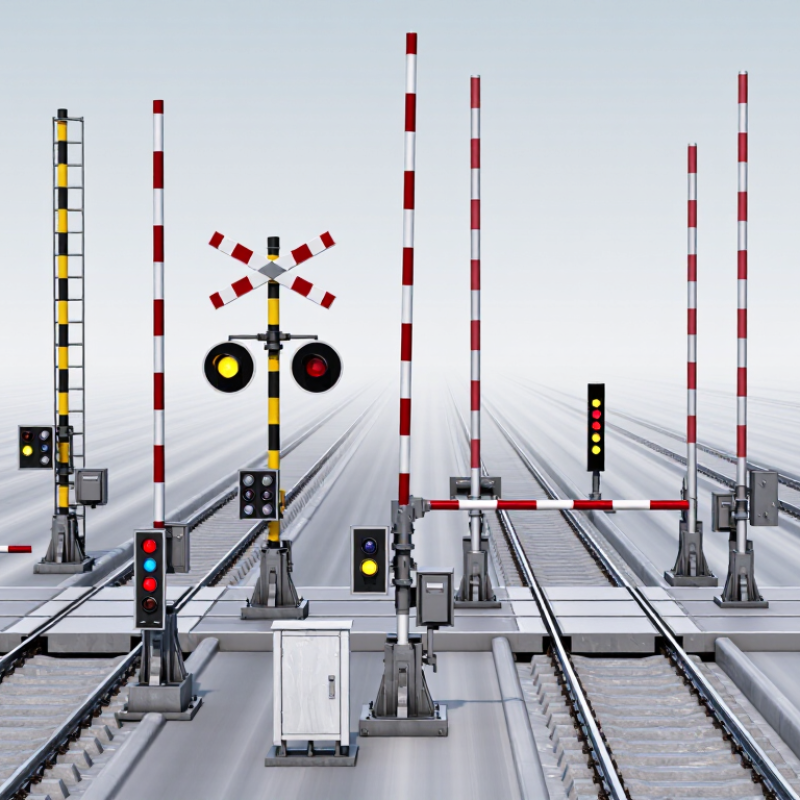
Rail crossing signals combine warning lights, bells, barriers, track sensors, and control equipment. When a train approaches, detection systems transmit its position to the crossing controller. Lights flash, alarms sound, and barriers lower before the train enters the road section. In busy areas, signals must respond quickly to frequent passenger and freight movements. In rural areas, equipment must remain dependable despite dust, rain, snow, and unstable power.
Reliability depends on more than hardware. Field technicians inspect cable connections, sensor alignment, barrier movement, and backup power. Control rooms also review alerts and unusual operating patterns. Small defects matter. A delayed barrier or dim warning lamp can confuse drivers and pedestrians.
Human behaviour remains difficult to predict. Some crossings have heavy traffic, narrow roads, or poor visibility near bends. Good signal design must account for these conditions, rather than rely on standard layouts alone. Manufacturers serving China’s large network need testing experience, disciplined quality control, and clear maintenance records. They also need to admit an uncomfortable fact: even advanced equipment cannot remove every operational weakness. Continuous inspection and practical redesign still matter.
| Rank | Manufacturer Capability Segment | Primary Application | Core Products and Functions | Role in China’s Railway Network | Capability Priority |
|---|---|---|---|---|---|
| 1 | Integrated Level-Crossing System Manufacturers | Main-line and high-traffic railway crossings | Complete crossing packages combining warning lights, audible alarms, automatic barriers, control units, train-detection interfaces, power supply and diagnostic functions. | Supports coordinated protection at crossings where road traffic and train movements must be controlled as one safety system. | Very High |
| 2 | Train-Detection Equipment Manufacturers | Automatic activation of crossing protection | Track circuits, axle-counting interfaces, wheel detectors and approach-section detection equipment used to identify train arrival, direction and clearance. | Provides the detection input required to start warning sequences before a train reaches the road crossing. | Very High |
| 3 | Automatic Barrier and Gate Manufacturers | Road-traffic exclusion at protected crossings | Motorized barrier arms, drive mechanisms, position monitoring, manual-release devices, obstruction response and fail-safe closing controls. | Physically separates road users from the railway when an approaching train creates a hazard. | Very High |
| 4 | Flashing Light and Audible Warning Manufacturers | Visual and acoustic warning for road users | LED warning lamps, crossbuck assemblies, bells, horns, warning signs, lamp monitoring and high-visibility signalling arrangements. | Provides immediate, recognizable warnings to drivers, cyclists and pedestrians before barrier closure or train passage. | High |
| 5 | Crossing Control and Interlocking Interface Manufacturers | Interface with railway signalling and control systems | Safety-related control logic, relay or electronic interfaces, status feedback, route protection, event recording and communication with railway signalling equipment. | Helps ensure that crossing status is consistent with train routes, operating rules and centralized railway supervision. | Very High |
| 6 | Obstacle Detection System Manufacturers | Detection of vehicles, people or objects trapped within the crossing area | Radar, laser, video or other presence-detection technologies, exclusion-zone monitoring, alarm generation and control-system interfaces. | Adds a supplementary safety layer by identifying obstructions after road access has been restricted. | High |
| 7 | Railway Signal Power and Backup-System Manufacturers | Reliable operation during power disturbances | Power distribution units, batteries, chargers, uninterruptible power supplies, surge protection, lightning protection and energy-status monitoring. | Maintains warning and control availability in remote locations and during interruptions to the normal power supply. | High |
| 8 | Remote Monitoring and Diagnostic Manufacturers | Centralized maintenance and condition monitoring | Remote status reporting, fault alarms, barrier-cycle records, lamp and battery diagnostics, communication gateways and maintenance dashboards. | Improves visibility across a geographically extensive railway network and supports faster fault response. | High |
| 9 | Railway Communication and Data-Transmission Manufacturers | Communication between field equipment and control centers | Industrial network equipment, optical-fibre links, serial communication gateways, wireless backhaul, network redundancy and cybersecurity-related controls. | Enables the exchange of alarms, equipment status and operational information between crossings, stations and railway control facilities. | High |
| 10 | Inspection, Testing and Lifecycle-Service Manufacturers | Commissioning, verification and long-term maintenance | Testing instruments, diagnostic software, maintenance tools, spare parts, inspection services, fault analysis and equipment modernization. | Supports safe operation throughout the service life of crossing equipment, especially at dispersed and high-use locations. | High |
Note: The ranking is a company-neutral capability ranking rather than a market-share ranking. It does not display company names, brand data or unsupported sales figures. China’s approximately 159,000-kilometre railway network requires crossing-signal solutions that combine train detection, warning, barrier control, power continuity, communications and lifecycle maintenance.