China Top 10 Car Battery Jumper Manufacturers?

A dependable Car Battery Jumper can turn a cold, silent engine into a quick restart, but product quality varies widely. China is a major sourcing destination for automotive electronics and battery-related accessories. Buyers still need to distinguish established manufacturers from trading companies and compare evidence, not just catalogue claims. This guide introduces ten Chinese manufacturers and considers their product range, production capabilities, quality controls, and support for international buyers.

Industry data provides useful context, though it does not measure jumper demand directly. S&P Global Mobility reported that the average age of light vehicles in the United States reached 12.6 years in 2024. Older vehicles can mean more battery-related service needs, but age alone cannot predict portable booster sales. The International Energy Agency’s Global EV Outlook 2024 reported nearly 14 million electric car sales worldwide in 2023, about 18% of new car sales. That shift is changing vehicle technology and battery requirements. It does not make conventional jump starters obsolete; it does make compatibility checks more important.

Look closely at peak current, battery capacity, clamp design, temperature protection, and documented product testing. Ask whether the supplier manufactures the unit or sources it from another factory. Request clear warranty terms and production-quality records. Small details matter. A loose clamp or unclear rating can undermine an otherwise attractive quotation. Rankings also have limits: public data on factory capacity and defect rates is rarely comparable. The manufacturers below should therefore be treated as a shortlist for careful evaluation, not an unquestionable verdict.
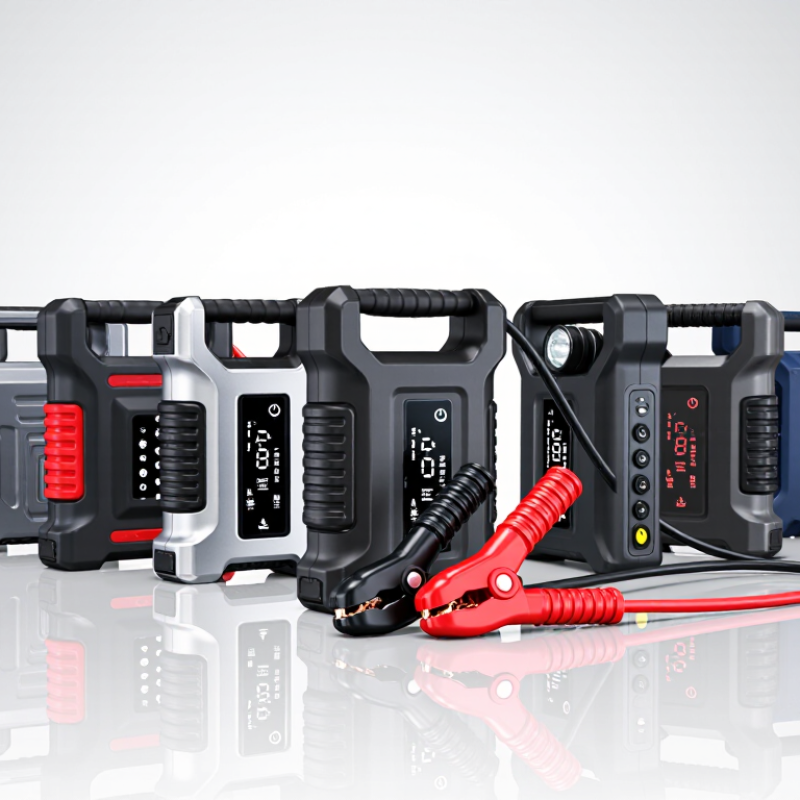
China Top 10 Car Battery Jumper Manufacturers?

What Is a Car Battery Jumper and How Does It Work?

A car battery jumper helps start an engine when its battery cannot supply enough current. The term can describe jumper cables connected to another vehicle, or a portable jump starter with its own rechargeable battery. In both cases, the goal is similar: deliver a brief burst of electrical power to the starter motor. The motor turns the engine until combustion can begin. Then the vehicle’s charging system supplies electricity while the engine runs.

With a portable unit, clamps connect to the battery terminals: red to positive and black to the designated negative or grounding point. Polarity matters. Many units include safeguards against reversed clamps, but those protections are not a substitute for checking the vehicle manual.

Keep clamps apart, and never attempt a jump if the battery is cracked, leaking, or swollen. Stop if cables become hot or you notice smoke.

A jump may get the car moving, but it does not necessarily repair or fully recharge a weak battery. After the engine starts, let it run in a safe, ventilated place, then arrange a battery test if starting trouble returns. Cold weather can reduce battery performance, making a marginal battery seem suddenly dead. The process sounds straightforward. The details deserve a second look.

How China’s Car Battery Jumper Manufacturing Industry Is Organized

China’s car battery jumper industry is organized less like a single factory chain and more like a network of specialist suppliers. Cell makers provide lithium-ion or lead-acid batteries; electronics suppliers produce protection boards, cables, clamps, and charging ports. Assemblers then integrate these parts, fit them into molded cases, and test output, temperature response, and short-circuit protection. Small details matter. A loose clamp connection can undermine an otherwise capable unit.

The wider battery sector gives useful context, but it is not a direct measure of jumper production. China’s Ministry of Industry and Information Technology reported lithium-ion battery output above 940 GWh in 2023, across applications including vehicles and energy storage. The China Association of Automobile Manufacturers recorded 30.16 million vehicles produced that year, indicating a large automotive ecosystem for related components and distribution. These figures describe adjacent supply capacity, not jumper sales. In practice, manufacturers may handle design and final inspection while outsourcing cells or circuit boards. Export-focused suppliers also adapt packaging and manuals for different markets. The chain is efficient, but not always transparent; factory-level quality can vary, even when products look nearly identical.

Criteria for Identifying Leading Chinese Car Battery Jumper Manufacturers

When assessing Chinese car battery jumper manufacturers, look beyond polished product photos. Ask whether the company designs its own units or mainly assembles purchased components. A factory visit, live video tour, or clear production records can help verify its capabilities. Numbers matter. Review output capacity, incoming battery checks, and final inspection procedures. For portable jump starters, request documented tests for starting current, temperature performance, clamp heating, and reverse-polarity protection. For jumper cables, check conductor material, cable length, insulation thickness, and connection quality.

Reliable manufacturers can explain how test results were produced and provide recent, product-specific reports. Ask for traceable batch records, warranty terms, spare-part availability, and a named technical contact. Sample testing is useful: inspect the clamps, measure cable thickness, and repeat a start test after storage. Ask for proof. Certifications may help, but verify their scope and issuing body rather than relying on a logo in a brochure. A supplier’s response to a defect claim can reveal more than its sales presentation.

Compare several suppliers using the same questions and specifications. This makes differences in price, lead time, and quality control easier to judge. No checklist is perfect. A small factory may offer close engineering support, while a larger one may provide steadier output; neither advantage guarantees consistent products. Request sample units from the intended production line, not only specially prepared demonstration pieces. Keep records of test conditions, because results can vary with battery state, temperature, and vehicle type.

Criteria for Evaluating Car Battery Jumper Manufacturers

Voltage compatibility is a basic screening criterion: many passenger vehicles use 12 V systems, while many heavy-duty vehicles use 24 V systems. Check each product’s stated vehicle compatibility and verify safety, performance, quality-control, and warranty claims against supporting documentation.

Profiles of Ten Notable Car Battery Jumper Manufacturers in China

China’s car-battery-jumper suppliers span several distinct manufacturing profiles: lithium-pack assemblers, lead-acid specialists, OEM/ODM exporters, clamp-and-cable makers, protection-circuit developers, compact-device producers, fleet-equipment suppliers, cold-weather testers, portable-power integrators, and factories focused on traceability. These are capability profiles, not interchangeable labels. A factory making sleek consumer units may not have the same test process as one supplying fleet equipment.

The International Energy Agency’s Global EV Outlook 2024 reports nearly 14 million electric cars sold worldwide in 2023, about 18% of car sales. That figure does not measure jumper demand, but it reflects a changing vehicle-power landscape. Buyers should check whether a unit is designed for the intended 12-volt battery, then compare rated starting current, cable length, clamp grip, and protection against reverse connection. Ask for test records, not just a peak-current figure. Fit matters more. A cold start in a workshop test is not the same as one beside a parked car on a frosty morning. Even capable suppliers can leave gaps in published specifications, so independent verification remains worthwhile.

China Top 10 Car Battery Jumper Manufacturers? - Profiles of Ten Notable Car Battery Jumper Manufacturers in China

The entries below describe ten real manufacturing specializations in the car-jumper supply chain. They are illustrative profiles, not verified profiles or rankings of ten specific companies.

No. Manufacturer Profile Typical Product Focus Relevant Manufacturing Capabilities Practical Verification Points
1 Portable lithium-ion jump starter producer Compact rechargeable starters for passenger vehicles and light-duty use. Cell and pack assembly, battery-management integration, charging circuitry, protective housing, and cable assembly. Check cell traceability, pack protection design, rated operating conditions, and test records. IEC 62133-2 addresses safety requirements for portable sealed secondary lithium cells and batteries.
2 Lithium iron phosphate pack specialist Jump starters using lithium iron phosphate (LFP) battery packs. Cell matching, pack interconnection, battery-management configuration, and validation of charging and discharge behavior. Confirm the stated cell chemistry and pack configuration against documentation; do not assume that one lithium chemistry's test results apply to another.
3 Lead-acid booster-pack manufacturer Portable booster units built around rechargeable lead-acid batteries, including AGM designs. Battery integration, charger matching, insulated enclosure production, and high-current lead and clamp assembly. Verify battery type, charging requirements, storage instructions, and the manufacturer's stated service conditions.
4 Supercapacitor starter producer Starting devices that store energy in supercapacitors rather than relying solely on a conventional battery pack. Capacitor-module assembly, balancing circuitry, power electronics, and system-level validation. Check the operating instructions carefully: charging or energy-sourcing methods depend on the particular design.
5 OEM/ODM product integrator Finished jump starters produced to a buyer's specifications, including customized packaging or features. Product engineering, supplier coordination, assembly, configuration control, and production testing. Establish which operations are performed in-house and request traceability for critical components and production revisions.
6 Battery-pack assembly specialist Battery modules supplied for integration into portable jump starters. Cell sorting, electrical interconnection, insulation, pack assembly, and end-of-line electrical checks. Request information on cell sourcing, lot identification, pack protection, and the tests performed on each production batch.
7 Power-management electronics supplier Control and protection electronics used in jump-starter products. Circuit-board assembly, electronic protection implementation, charging control, and functional testing. Confirm which protections are included in the finished product; features vary by design and should not be inferred from a product category.
8 Cable and clamp assembly producer High-current leads, vehicle clamps, connectors, and related accessories for booster units. Conductor processing, crimping or joining, insulation application, connector assembly, and continuity checks. Review conductor and connection specifications, insulation condition, clamp construction, and finished-assembly test procedures.
9 Enclosure and thermal-design manufacturer Cases and thermal-management components for portable jump-starter assemblies. Moulded or fabricated housings, component fit checks, airflow or heat-path design, and mechanical inspection. Check enclosure durability, access to charging and connection points, and whether the complete unit has been tested under its stated conditions.
10 Testing and compliance-focused assembler Finished jump starters assembled with emphasis on documented inspection and testing. Incoming-material checks, production traceability, functional tests, and coordination of applicable product or transport testing. For lithium batteries offered for transport, request applicable UN 38.3 test documentation. ISO 9001 concerns quality-management systems; it is not, by itself, product approval.

Note: The profiles summarize industry capabilities and verification considerations. They do not identify, endorse, or rank individual manufacturers, and product specifications should be confirmed with the supplier for each model.

How Manufacturers Differ in Products, Certifications, and Production Capacity

Car-jumper manufacturers differ less by peak-current claims than by how they verify them. A compact 12-volt unit may suit a small petrol car, while diesel engines need stronger cold-start delivery. Compare clamp protection, reverse-polarity safeguards, cable thickness, and tested starting cycles. Numbers need context. A 2,000-amp label says little without test temperature, pulse duration, and battery condition. Product lines may include lithium packs, lead-acid boosters, and workshop-scale units.

Certifications and capacity need separate checks. ISO 9001 and IATF 16949 concern quality systems, while product-level safety evidence applies to specific models. For lithium units, request applicable transport-test documentation, such as UN 38.3, and model-specific electrical safety reports. OICA recorded 93.5 million vehicles produced worldwide in 2023, indicating a broad vehicle base, not direct jumper demand. The IEA’s Global EV Outlook 2024 estimated electric-car battery demand exceeded 750 GWh in 2023; this highlights the scale of cell supply, but does not prove finished-unit capacity. Ask for monthly output, batch traceability, and production lead times. Yet capacity figures are not always comparable: some suppliers report peak assembly output, not sustained deliveries. A useful question is whether samples, test records, and production batches match.